A Tenth Doctor Adventure
One: The Man on the Bus
Before any of it — before the archive, before the mast, before the thin thing in the equipment racks — there was a man on the number 14 bus into Hull, and his name was Gerald, and he had been kind for sixty-one years.
Gerald had fixed his neighbour’s guttering for nothing. Gerald cried at the end of films and pretended it was hay fever. Gerald had once driven eleven miles at midnight to collect a stranger’s daughter from a petrol station because he’d heard her crying on the phone in the next seat.
On the seventeenth of July, 2026, Gerald sat on the number 14 with his headphones in, listening to a man on a screen, and somewhere under the man’s voice — beneath the register where human hearing bothers to go — something murmured.
And a small ugly thought that Gerald had kept locked in the back of his head for forty years, the sort of thought most people have and nobody airs, the sort you’re ashamed of and dismiss and forget —
— that thought got very, very loud.
Gerald got off two stops early. He did not know why. His hands were shaking and his heart was full of a wonderful, terrible certainty, and he had never in his life felt so right about anything.
Somewhere above the Humber, something that was not remotely a person finished its meal, and looked round for the next one.
Two: Shelf Fourteen
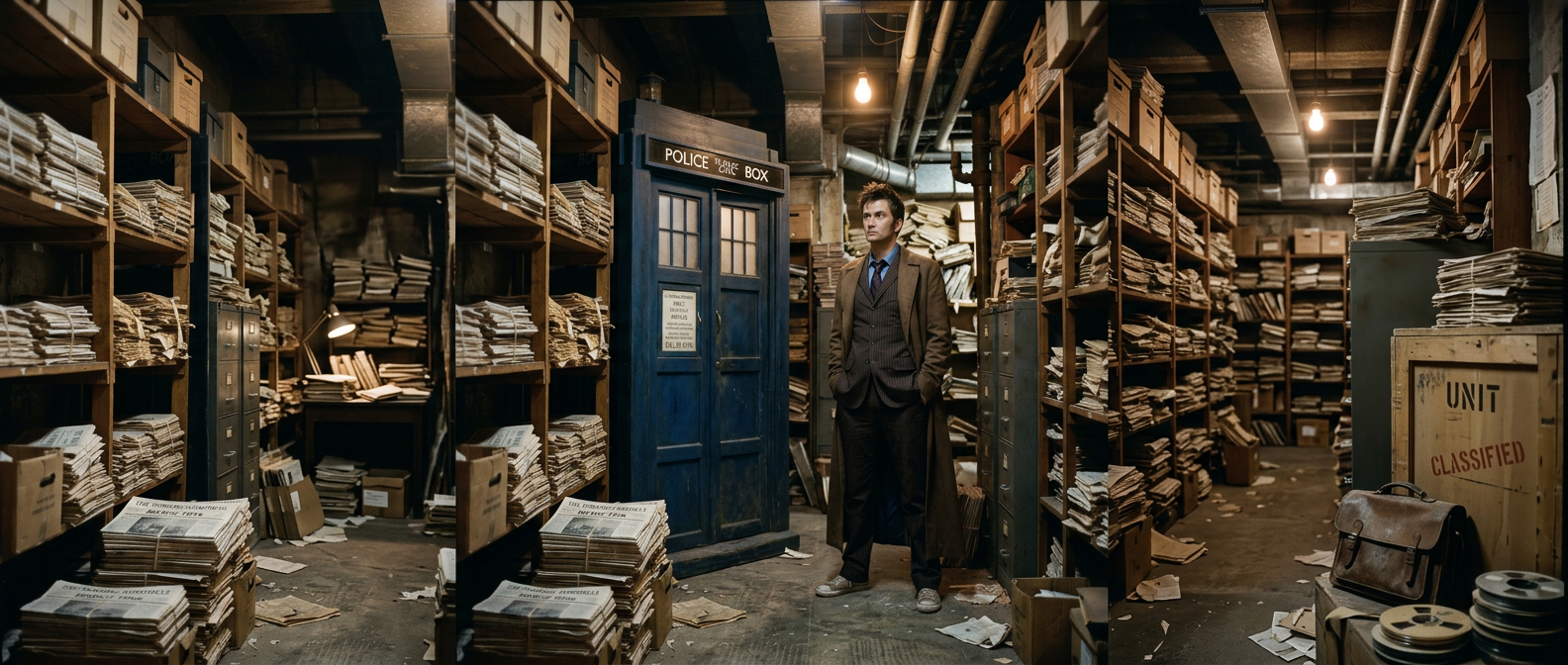
The basement of the Humber Sentinel smelled of vinegar, dust, and forty years of nobody caring. Dorota Kowalczyk liked it that way.
Everyone called her Dot, including her mother, who had picked Dorota specifically so that nobody would. She was twenty-seven, she worked nights, and she was the last archivist of a newspaper that had once employed nine of them. The building above her had been sold to a company that wanted to turn it into flats. Her job existed only because of a clause in a will written in 1963 by a man who had loved paper considerably more than he’d loved his children.
She was, she often thought, the custodian of a very large filing cabinet nobody would ever open again.
At 2:14 in the morning, a wheezing, groaning noise filled the room — the sound of something enormous being dragged very carefully through a door far too small for it — and a blue police box scraped itself into existence between Shelf 14 (LOCAL SPORT, 1978–1994) and the dehumidifier.
Dot did not scream. She had worked nights for four years. Screaming was for people with energy.
She looked at it for a while. Then she said, to nobody in particular: “That’s a police box. They stopped making those in the sixties.”
The door banged open and a thin man in a brown pinstripe suit and battered white trainers came out at a speed suggesting he’d been running long before he arrived and simply hadn’t got round to stopping.
“Yes! Well spotted! Most people say shed.” He halted dead. Sniffed the air. Turned in a slow, delighted circle. “Ohh. Oh, that’s paper. Real paper. Actual, physical, irreplaceable paper. Do you know how rare that is in this century? Everybody’s put everything in the cloud, which is a marvellous idea right up until somebody in Utah spills a coffee and the twentieth century stops existing.” He whirled and shot out a hand. “I’m the Doctor.”
“Dot.”
“Dot!” he said, as though she’d told him something wonderful. “Dot. Small, essential, ends sentences. Excellent name. Doctor of what, you’re about to ask.”
“I wasn’t, actually.”
He faltered — genuinely thrown — and she decided on the spot that she liked him.
“Everyone asks.”
“I’ve had four years of night shifts, mate. I’ve stopped asking things.” She nodded at the box. “Is that yours?”
“She is.”
“Does she have a licence to be parked in a fire escape?”
“She has,” said the Doctor, “a complicated relationship with licences,” and went straight past her to the terminals.
Three: Eleven Minutes
He found the archive’s search interface in about nine seconds, which annoyed her, because it had taken her three weeks. Then he did something to it with a silvery device that buzzed and glowed blue, and the screens went from one page to eleven, and eleven to a hundred and eleven, headlines strobing past far too fast for anything with eyes to read.
“What are you doing?”
“Reading.”
“You are not.”
“I’m really very good at it. Ssh.” His eyes moved in tiny flicks, left-right, left-right, faster than a metronome. “Local first. Always local first. The national press tells you what a country wants to believe about itself. The local press tells you what’s actually happening in it. Births, deaths, planning applications, furious letters about dog mess — that’s a civilisation’s pulse, that is.” Flick. Flick. Flick. “Now widen. Wires. Reuters, AP, AFP, the syndicate feeds — good, good, you’ve got the lot down here, whoever kept these subscriptions alive is a hero —”
“That’s me.”
“Then you’re a hero,” he said, absently, and she found that it landed somewhere under her ribs and stayed there.
He read for eleven minutes. She timed it, because she didn’t know what else to do with herself. Eleven minutes standing perfectly still while ten years of the world went past like a card shuffle.
Then he stopped. And he’d gone very quiet, which she would learn — much later, on a beach that wasn’t on Earth — was by far the most alarming thing about him.
“Elections,” he said. “Referendums. Riots. Trials. Treaties, torn up. Aid budgets, gone. Borders. Camps.” He swallowed. “You built camps again. That took you sixty years to unlearn and about six to —”
He stopped himself.
“Right,” he said. “Right. Now listen, because this is important. I don’t do politics.”
“Bit of a weird thing to announce.”
“It’s a rule. Big rule of mine, one of the oldest.” He turned round, hands doing something restless in the air, as though trying to hold a shape. “People sort out their own governments. That is the entire point of people. You’re meant to be a shambles. You’re meant to argue about drainage for nine hours and then go to the pub. That’s how I know it’s working. The day a planet starts agreeing with itself is the day I start checking under the floorboards, because it means somebody has put something there.”
He gestured at the screens, and every one of them was frozen on a different country.
“But this is not right. This is not right at all.”
Four: The Spiral
He made her print things. Actual printouts, hundreds of them, laid out across the concrete floor in a widening spiral, because he thought better in three dimensions and had, he claimed, once ended a war by rearranging some pebbles.
“Twelve changed histories?” he said, crouched in the middle of it in his shirtsleeves, tie thrown back over one shoulder. “Twelve, in ten years, all lurching the same direction at roughly the same speed. Which does not happen. History is a drunk man on a bicycle. It wobbles, it falls in a hedge, it gets up, it goes the wrong way down a one-way street. It does not march in step. Not across twelve timelines’ worth of completely unrelated grievances.”
He tapped a page. Then another. Then a third, three feet away.
“And every single one of them has a thread running back to this bloke.”
Dot came and looked over his shoulder.
A wide, gleaming face under an architectural haircut. An orange the colour of a traffic cone left out in the sun. Drump, said the headline, sixty-point bold.
“Rolly J Drump” she said. “Everyone knows Rolly Drump.”
“That,” said the Doctor, “is precisely the problem.”
Five: Things the Doctor Had Personally Witnessed
He got up. He started pacing. When the Doctor paced his whole body was involved; he was a man who thought with his elbows.
“Because I know Rolly Drump, Dot. I don’t mean I’ve read about him. I mean I have been in rooms with him. Repeatedly. Entirely by accident. And every time I have come away with the same conclusion, which is that here is a man with the interior life of a bathroom tile.”
“You’ve met him?”
“Nineteen seventy-eight,” said the Doctor. “Manhattan. I was there for something else — long story, involved a lift shaft and a great many eels — and this young lad has inherited the family frozen-custard money and decided what the world urgently requires is a marina. Not a marina. Marinas. Plural. A chain. He’s got a scale model in the lobby and he’s showing it to a journalist, and he says — and I remember it word for word, because it was the first time I ever heard a human being do it — he says: ‘People are calling it the greatest marina anyone has ever built. Everyone says so. Everyone.’“
“And had they?”
“He’d been building it for eleven days. It was a hole. Full of rain.”
Dot laughed. It came out of her like a hiccup. She hadn’t expected it.
“And that was the fascinating bit,” the Doctor went on, spinning round. “He wasn’t lying the way people lie. Lying is a skill. Lying is work. You have to hold two worlds in your head at once — the true one and the useful one — and keep them from touching. It’s exhausting. That’s why liars get tired and eventually get caught, because sooner or later they drop one.” He tapped his temple. “He didn’t have two worlds. He had one. He was in the middle of it. And anything unflattering simply didn’t get in. He’d say a thing and it became true in there, instantly, no resistance whatsoever. Like dropping a stone into a pond with no water in it.”
“That’s horrifying.”
“It’s restful, apparently. Never known a man sleep better.” He was off again, arms going. “Nineteen eighty-seven. Atlantic City. Boxing match. I was two rows behind him because a Sontaran was trying to buy the venue, don’t ask —”
“I wasn’t going to.”
“— and he spent all twelve rounds explaining to the man beside him what he would have done in the ring. Rolly Drump. Whose sole recorded physical achievement is falling off a jet-ski in front of the world’s press in 1994 and describing it afterwards as a controlled dismount.”
“Stop.”
“Nineteen ninety-one. Cleveland. He opened a shopping centre and got stuck in his own revolving door for one minute and forty seconds. I timed it. Then he blamed the door. Issued a statement blaming the door. Called it — and again, word for word — ‘a very unfair door. Everybody’s saying it. Terrible door.’“
“Stop.“
“Two thousand and four. Chat show. Mispronounced the name of his current wife. Twice. Two different ways. The host tried to help him and he explained to her, patiently, at length, with a hand on her arm, that she was saying it wrong.” He flung his arms wide. “And the tan, Dot! The tan. I have stood on worlds with three suns. I have walked on the crust of a star. I have never seen anything the colour of that man’s face. It has a tide line. There is a distinct geological boundary at his jaw where the orange stops and the man begins, and you can date it, like rock strata. Somewhere in New Jersey there is a leather chair that has never recovered and a cleaner who has seen things.”
He stopped in front of the spiral, breathing hard. And then the grin came off him like a mask.
“And in between all of it,” he said, more quietly, “there was the other thing. The way he talked about women when he thought the room was on his side. Like they were fixtures. Like they came with the building, and he was checking the fittings. And every single time, Dot — every time — I watched a room full of otherwise decent people decide it was easier to laugh than to say anything. And I thought: there. That’s the crack. Not the man. The man’s nothing, the man’s weather. The laughing. That’s where a thing gets in.”
Silence in the basement. The dehumidifier hummed to itself.
“So here’s my problem,” he said, crouching again. “That man does not win the most powerful position on earth. And that’s not snobbery, that’s arithmetic. Charisma’s a real force — I’ve seen it move armies, I’ve seen a man in a mud hut on Vollus Prime hold nine warring tribes together with nothing but a good voice and better jokes. This is not that. This is a man who once tried to launch an airline under the slogan ‘Drump Airlines: You’re Going to Get There.’ Which he then had to withdraw.”
“Why?”
“Because it turned out to be legally actionable.” He looked up at her, and there was nothing funny left in his face at all. “He is not winning, Dot. Something is winning through him.”
Dot folded her arms. She’d been thinking while he talked, and she was an archivist, and archivists are contrary by trade.
“Or,” she said, “people just liked what he said.”
The Doctor went very still.
“Yeah,” he said. “That’s the bit that’s going to be horrible later.”
Six: Uncle Marek
He wanted to see somebody it had happened to. Dot took him to her mother’s.
It was four in the morning and the kitchen light was on, because it was always on, because her mother had worked shifts for thirty-one years and had lost the ability to be asleep at sensible times. And sitting at the table with a cold tea in front of him was Uncle Marek.
Marek Kowalczyk had come over in 1989 with two bags and no English. He’d worked in a chip shop, then owned it, then owned two. He had personally sponsored the visas of four people. At Dot’s christening he had cried so much they’d had to give him the tea towel.
He looked up when they came in, and his eyes were wrong.
“Dorota,” he said, warmly. “Who’s this?”
“Friend from work.”
“Good.” Marek smiled at the Doctor. He had a lovely smile. He always had. “You know what they should do —”
And then he said the thing. He said it easily, comfortably, like a weather report — an idea with barbed wire wound through it, about people who had arrived exactly the way he had arrived — and he said it while smiling, and then he asked whether they wanted a biscuit.
Dot’s mother, at the sink, did not turn round.
The Doctor didn’t move. He’d gone unnaturally still again, and Dot realised he wasn’t listening to Marek at all. He was listening to the room, head very slightly tilted, like a man tuning something.
“Marek,” he said pleasantly. “Where’d you get that thought from?”
“It’s common sense.”
“Yeah, but where from? Which day? Which bit of your life did you pick it up in?” He leaned forward onto his knuckles, still perfectly friendly. “Because I’d put money you’ve had it a long while. Little thing. Back of a drawer. Something you’d have been ashamed of if it ever got out into daylight. Am I close?”
Marek’s smile flickered — and for half a second something behind his eyes was frightened, and awake, and trying to get out — and then it smoothed over like water closing.
“You should have a biscuit,” he said. “You’re too thin.”
Out in the street the Doctor stood with his hands in his pockets, looking at the filthy orange sky over the estuary, and said nothing for a long time.
“He’s a good man,” said Dot. Her voice had gone unreliable on her. “He is a good man.”
“I know.”
“Then what —”
“There’s a hum.” He tapped his ear. “Under everything. Under the broadcast, under the ad breaks, under the little jingle at the top of the news. Sub-audible, riding the carrier signal. You can’t hear it — your ear isn’t built for it. But the part of your brain that decides what’s obvious hears it beautifully.”
He turned to her.
“And it doesn’t put ideas in. That’s the thing I need you to understand before we go one step further. It found something that was already in him, and it turned the volume up until he couldn’t hear anything else he’d ever thought. Everything else is still there. The chip shop. The visas. The tea towel at your christening. All of it, still in there, being drowned out by one nasty little forty-year-old thought with a megaphone.”
“Can you turn it down?”
“Oh,” said the Doctor, already walking, coat snapping out behind him, “I can do considerably better than that. Come on. Broadcast mast on the ridge. Bring a coat, it’s going to involve a lot of running.”
“I’m rubbish at running.”
“Everybody’s rubbish at running,” said the Doctor. “They just do it anyway. That’s the entire species in one sentence, that is. Allons-y!”
Seven: A Lot of Running
She was, in fact, rubbish at running, and she did it anyway — up a hillside in the grey pre-dawn behind a man who talked the whole way without once getting out of breath, which she considered a personal insult.
The mast stood against the sky like a bad idea. It hummed: the ordinary hum of a great deal of electricity going somewhere. But underneath that, in the place where a sound ought to have stopped and didn’t, there was something else. A murmur. Like a very large room full of people all agreeing at once, forever, and enjoying it.
The Doctor put his ear to the cold steel and closed his eyes.
“Oh, you’re clever,” he breathed. “You’re horrible, and you are so clever.”
Then the security floodlights came on all together with a bang like a dropped tray, and four men in high-vis came round the base of the mast with their faces slack and their eyes wrong and their hands hanging open, and the Doctor grabbed her hand and said “Run,” and after that there was no conversation for quite a while.
They went down a service road, over a fence Dot would later have no memory whatsoever of clearing, across a car park, and into the back of a substation, where the Doctor did something to a locked door with the buzzing silver device, shoved her through it, shut it, and held up one hand for silence while four sets of footsteps went past outside without hurrying.
They never hurried. That was the worst part. They walked like people who had all the time in the world, because they were already right.
“Sonic screwdriver,” the Doctor whispered, before she could ask.
“That’s not a thing.”
“It is absolutely a thing.”
“Screwdrivers turn screws.”
“Yes! And this one turns them with sound, which is —” He caught her expression. “Oh, you’re going to be one of the ones who takes the mickey, aren’t you.”
“Yeah,” said Dot. “Sorry.”
“No,” said the Doctor. “Don’t be.” And he looked, for a moment, almost unbearably pleased.
Eight: The Murmurants
They came up into the transmitter control room at twenty to six in the morning, and it was empty.
Then it wasn’t.
The thing unfolded itself out of the equipment racks, and thin was the word Dot’s brain kept offering her, uselessly, over and over. Thin — as though someone had cut a person-shaped hole out of the air and the hole had opinions. It moved in the gaps between things. Looked at directly it was mostly a sound: the roar of a stadium, heard through a wall.
“Murmurants,” said the Doctor, putting himself between it and Dot without appearing to move at all. “Consensus predators. Hello.”
YOU ARE NOT OF THIS WORLD.
The voice arrived somewhere behind her jaw. It had no volume. It simply became something she had always known.
“No. And neither are you, and only one of us is being rude about it.” He shoved his hands in his pockets. “Go on then. Tell her what you eat. She’s an archivist. She likes a primary source.”
WE DO NOT LIE. WE AMPLIFY.
“They eat certainty,” said the Doctor, and there was acid in it now. “Not flesh — nothing so honest. Big warm heaping plates of absolute conviction. And the vintage of vintages, the thing they’ll cross a galaxy for: a frightened person who has just been handed somebody to blame.” He took a step forward. “But you can’t make anybody hate anything. Can you. Not one thing. You haven’t got the imagination for it. All you can do is go rummaging through the ugly back rooms of a mind — and everybody’s got one, everybody, me included — find the worst thing in there, and turn it up until it’s the only thing they can hear.”
AND THEY THANK US.
“Yeah,” said the Doctor. “I’ll bet they do.”
He began to walk a slow circle, and the thin thing turned to follow him, and Dot understood with a lurch that he was doing it deliberately — putting himself where the eyes were.
“So you needed a transmitter. Something already pointed at every human being on the planet. Something with a permanent licence and a face they’d all already agreed to look at.” He stopped. “And you went hunting for the loudest room on Earth. Not the cleverest man. Not the strongest. The emptiest. Somebody with nothing inside to argue with you. And there he was — a bloke who’s been shouting into a microphone since 1978, who has never once been contradicted by his own conscience because he doesn’t keep one on the premises, who thinks a hole full of rain is the greatest marina ever built.”
HE WAS ALREADY WHAT HE IS.
“I know,” said the Doctor, and suddenly he sounded very tired. “That’s the sick joke, isn’t it. You didn’t even have to build him.”
THE WORLD WILL BE QUIET. The murmur rose behind Dot’s jaw, and it was almost loving. THEY ARE ALREADY ENDING THEMSELVES. WE HAVE ONLY TO WAIT. WHEN THE AIR IS OURS AND THE WATER IS OURS, WE SHALL SEED IT. AND THOSE THAT REMAIN WILL SERVE.
“Ah,” said the Doctor. “No.”
YOU CANNOT—
“No, sorry, we’re doing this bit now.” And he was, abruptly, not pleasant at all. “You’re the ninth species I’ve met this century with a plan that ends in and then they’ll serve us. Do you know what happened to the other eight? They ran into one very specific problem, which is that this lot —” he jabbed a thumb backwards at Dot without looking “— are the single most contrary organism in the observed universe. Tell a human what’s obvious and half of them will go and check. It is their worst quality and it is the only reason they’ve still got a planet.”
“Doctor,” said Dot, very quietly, “what’s it doing?”
Because the thin thing wasn’t attacking. It was settling — spreading itself out through the racks, into the wiring, into the signal — and the hum was rising, and rising, and rising.
“Ah,” said the Doctor. “It’s having its breakfast. It’s just told us the whole plan, which means it thinks we’re already on the menu, which means —” He seized her wrist. “Dot. Look at me. What’s the last thing you were absolutely certain about?”
She opened her mouth to say nothing — and found instead a thought sitting right at the front of her mind, glowing, comfortable, warm as a bath: Marek said it because it’s true. Everyone knows it’s true. You’ve always known.
“Oh,” she said. “Oh, that’s not mine.”
“No,” said the Doctor. “It isn’t. And the fact you can tell is the most impressive thing I have seen all week. Hold onto that. Doubt it. Doubt it hard.“
And the murmur flinched.
He saw it. She saw him see it. His whole face changed.
“Oh,” he breathed. “Oh, you poor, thick, hungry thing. You’ve been eating certainty for six thousand years and you’ve forgotten how to digest anything else. You can’t hold a question. It’s soap. It’s a wet bar of soap and you have got no hands.” He spun to Dot. “That’s why you never went near the awkward ones, isn’t it. The doubters. The pedants. The ones who ask for the receipts.”
Dorota Kowalczyk — night archivist, last custodian of a very large filing cabinet nobody would ever open again — felt the entire world rotate one click and lock into place.
“I’ve got ten years of receipts in a basement,” she said.
“Dorota Kowalczyk,” said the Doctor, “I could kiss you. I won’t, it’s a whole thing, it never ends well. But I could.”
Nine: The Broadcast
Here is what they did in the forty minutes before the morning news.
The Doctor did something frankly obscene to the transmitter’s uplink with the sonic screwdriver, hooking it backwards into the Murmurants’ own carrier signal — the beautiful, patient, global network they had spent ten years building for exactly this purpose, running into every phone, every screen, every hall, every pair of headphones on every number 14 bus in the world.
And Dot opened the archive.
Not the arguments. The Doctor was absolutely clear about that. Arguments bounce; an argument is just certainty wearing a hat. What she sent was the contradictions — the dull, unanswerable machinery of the record. Every promise beside its retraction. Every front page beside the front page that followed it. Every figure beside the corrected figure printed three weeks later on page nineteen where nobody ever looks. A decade of a world saying one thing on Tuesday and its precise opposite on Friday, laid side by side, with no commentary at all.
Not you are wrong.
Just: are you sure?
“It’ll fight,” said the Doctor, hands flying over the console. “Second it feels the signal turn, it’ll grab every mind it’s got and squeeze. Which means somebody has to go first. Somebody has to put the first real doubt into that network, live, and mean it, or the whole thing’s just noise.” He looked up. “And it has to be somebody with a very, very loud mind.”
“You,” said Dot.
“Me.” He picked up the microphone and regarded it the way you regard a dentist’s chair. “Right. Never done this bit sober.”
He pressed the switch.
“This is the Doctor,” he said, to eight billion people. “You don’t know me. Doesn’t matter. I’m going to tell you three things, and then a friend of mine is going to show you some newspapers.
“One. I am nine hundred years old and I have been wrong. Not occasionally. Constantly. Spectacularly. I have been so certain I was right that people died of it, and I have had to go on living in the house afterwards. I’m probably wrong right now, about something, in a way I won’t notice for a century.
“Two. There is a thing in your air. It has spent ten years finding the worst thought you ever had and making it the loudest one. It didn’t put it there — that part’s yours, I’m sorry, that part was always yours. But it turned the dial. And you have been shouting ever since, and you are tired, aren’t you? You must be so very tired.
“Three.” He paused. “You are allowed to not be sure. That is not weakness. That is the strongest single thing a mind can do, and it is the only thing in this universe these creatures cannot eat.
“So. Here’s ten years of you. Have a look. And then ask yourself one question — and it isn’t who’s to blame. It’s much worse than that.”
He leaned in.
“Are you sure?“
And Dot hit send.
Ten: Eleven Minutes, Again
It took eleven minutes.
The Murmurant came apart somewhere in the fourth. Dot watched it happen and could never afterwards describe it properly; the nearest she ever got, years later, on a beach that wasn’t on Earth, was it sounded like a stadium emptying. All that agreement going out of it at once, and nothing underneath. There had never been anything underneath. That was the whole of them.
Across the planet, in halls and living rooms and on the top decks of buses, several hundred million people put a hand over their mouth.
At a rally in a converted aircraft hangar outside Tulsa, a man in a spray tan the colour of a traffic cone stopped mid-sentence, because his crowd had stopped making the noise, and he had genuinely never encountered silence before and had no idea what it was for. He tapped the microphone. He told them they were the greatest crowd anybody had ever had. Nobody said anything at all. It is recorded that he asked, twice, whether the sound was broken.
And on the number 14 into Hull, a sixty-one-year-old man called Gerald took out his headphones and sat very still with his hands shaking, and then got off at the next stop and was sick in a bin — because he had just remembered every single thing he had said and done for ten years, all at once, and he had been kind before it, and he would have to be kind again afterwards, and there was a very long stretch in the middle that belonged to him whether he liked it or not.
Eleven: Drainage
Dot watched the aftermath on a cracked phone, sitting on the hillside with the sun coming up filthy and orange over the estuary.
People in a square in Warsaw, standing very still, looking at their hands. A minister in Brasília walking out of a press conference mid-sentence. Three resignations before lunch and eleven by the weekend — and then, once the various financial regulators of the world finally got a clear run at ten years of Vandergrift Holdings without a fog of adoration in the way, the indictments. Fraud, mostly. Which the Doctor said was the great historical irony: the big ones almost always go down for the paperwork.
He’d be in a courtroom before Christmas, looking baffled and small, a loudspeaker in a suit, wondering where the noise had gone. He would never understand what had happened to him. There was nothing in there to understand it with.
Elections were called in nine countries. Two of them went exactly the same way as before, which the Doctor said was important, and Dot said was depressing, and the Doctor said was both.
“So that’s it,” she said. “It goes back to normal.”
“Mostly.” He was sitting with his elbows on his knees, and he did not look like a man who had won anything. “Elections. Recounts. Committees. Long, dull, vicious arguments about drainage. Best sound in the universe, a really tedious council meeting. That’s the noise a species makes when it’s decided to stay.”
“You don’t look happy.”
“No.” He picked at the grass. “Because here’s the bit everyone skips, Dot, and I need exactly one person on this planet to actually hear it. They didn’t put anything in. Not one thing. Not a single idea. Every last bit of it was already there — homegrown, human, sitting in the back rooms with the light off, waiting. All they did was find the dial.”
“That’s horrible.”
“It’s hopeful,” he said, “which is much worse, because it means it’s yours.” He stood and brushed himself down. “So turn it down yourselves. Ask each other awkward questions. Be the pedant at the table — everyone will hate you, do it anyway. And keep the archive. Keep the boring, unglamorous, unread record of what was actually said on the actual day. Because that is the only weapon that has ever worked against this, and it lives in a basement, and nobody funds it.”
“They’re turning my basement into flats.”
“Then be a nuisance about it,” said the Doctor. “You’ll be brilliant at that.”
He stretched. And the TARDIS was standing at the bottom of the field, where it had definitely, definitely not been.
“Right. Dorota Kowalczyk. Night archivist. Rubbish at running.” He clicked his fingers and the door swung open on golden light and a sound like something enormous breathing. “There’s a library on Kastria Nine where the books argue back. Properly argue. One of them threw a chair at me. Fancy it?”
Dot looked at the sunrise. Then at her phone, where her mother had texted marek is crying come round. Then at the box.
“Will I be back?”
“Ten minutes after you left. Usually.”
“Usually.“
“It’s a very big machine,” said the Doctor, “and I am an excellent driver,” and the way he said it made her fairly certain that both halves were lies.
She stood up. Her legs hurt. Everything hurt. She had never been so awake in her life.
“Fine,” said Dot. “But I’m bringing a coat.”
© Kyle Lewis 2026. All rights reserved.